
Moving Company Scams
You’ve found the mover. The price looks right. Everything feels fine…until it doesn’t.
Moving company scams often feel like a normal transaction right up until the moment they aren’t. Understanding the actual mechanics of the scam is what puts you in a position to walk away before you’re in one.
Bekins Van Lines has been moving families and businesses since 1891. In that time, we’ve seen every variation of moving fraud that exists, and we’ve built our standards specifically to close the doors those scams walk through.
Learn the most common moving company scams, how each one unfolds, and something most moving guides haven’t caught up to yet: what AI has added to the scammer’s toolkit in 2026.

The Core Pattern Behind Moving Company Scams
Before we get into specific moving company scams, let’s talk about the pattern. Every moving scam exploits the same structural vulnerability: you hand over something valuable before you know who you’re actually dealing with.
Your deposit. Your signed estimate. Your furniture, loaded onto a truck. The moment control transfers to them, your leverage disappears. Every scam on this page is just a variation on how they manufacture that moment and what they do with it once it arrives.
The BBB’s moving scam study documents exactly this pattern at scale: price gouging, hostage-taking of belongings, and deliberate destruction of goods. Knowing this matters because scammers adapt. If you only memorize a list, a slightly different version slips through. If you understand the underlying structure, you’ll be able to recognize a variation the list didn’t include.
Common Moving Company Scams
Most people encounter these scams without recognizing them until it’s too late. The following breaks down each common moving company scam so you can recognize one while you still have room to act.
1. The Hostage Load Scam
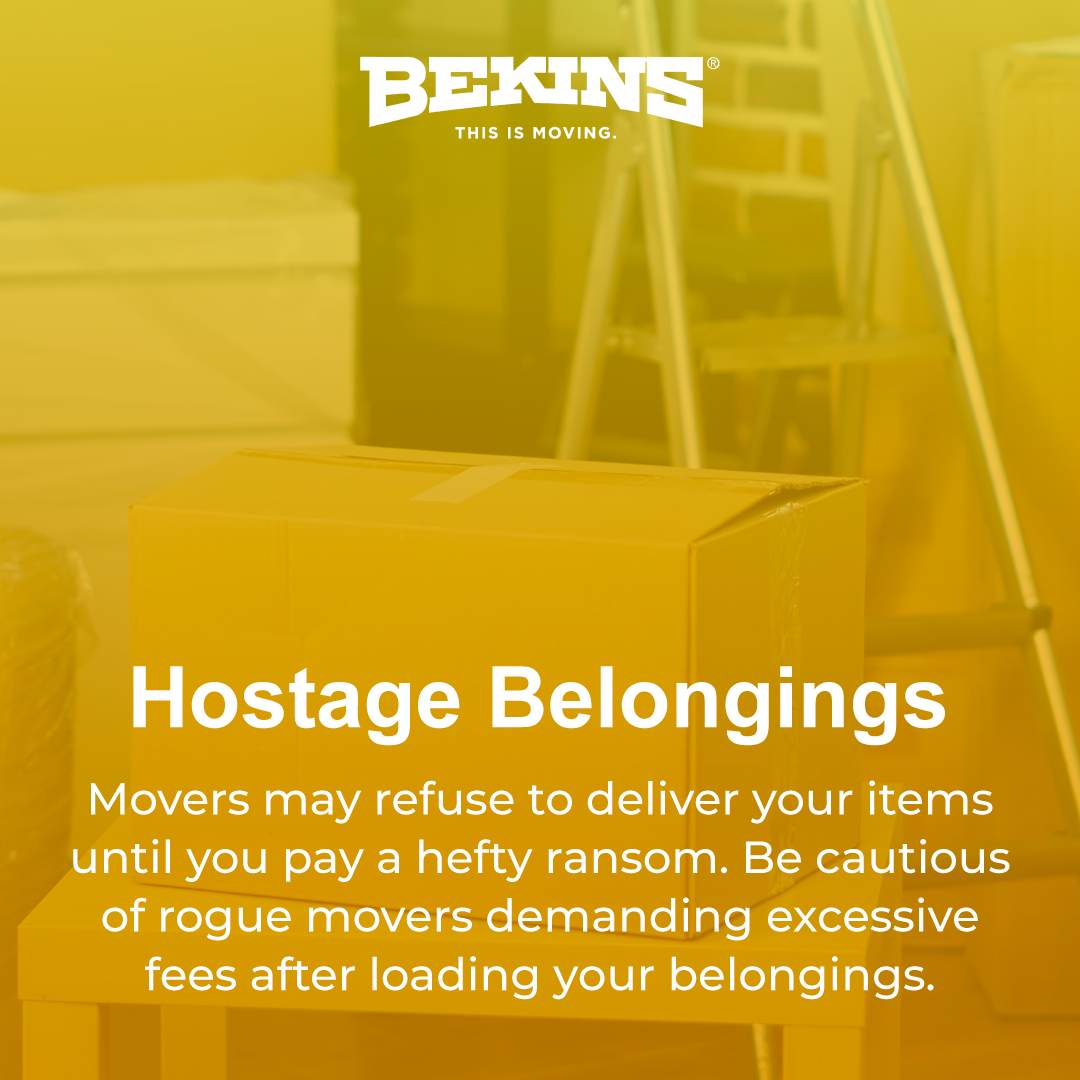
This is the most reported moving company scam, and the most emotionally brutal. A mover gives you a low estimate, often over the phone or online, without seeing your home. On moving day, they load everything.
After loading your belongings onto the moving truck, rogue movers might refuse to deliver your items until you pay an exorbitant amount of money. Movers may disappear and hold your possessions hostage until you meet their demands.
The explanation varies: more cubic footage than estimated, extra fees for stairs or long carries, fuel surcharges that weren’t mentioned before. The number is sometimes double the original quote. Sometimes more.
This works for rogue movers because by the time you realize what’s happening, your belongings are already gone. You can call the police, but this is frequently treated as a civil dispute rather than theft. You can refuse to pay, but they can legally place a lien on your goods in many states. Most people pay.
The scam depends entirely on that loading moment. Before your furniture is on the truck, you have options. After it is, you have very few.
How to Avoid This Scam
What closes the door on this scam is an estimate, in writing, before a single box is touched. Bekins offers three estimate types: non-binding, binding, and not-to-exceed; so you can choose the level of cost certainty that fits your move.
A binding estimate locks your price completely. A not-to-exceed estimate caps what you’ll pay while leaving room for the final cost to come in lower. Either way, the number on delivery day cannot simply be invented after the truck is loaded.
2. The Bait-and-Switch Estimate
While related to the hostage scam, the bait-and-switch estimate scam operates even when no one holds your belongings hostage.
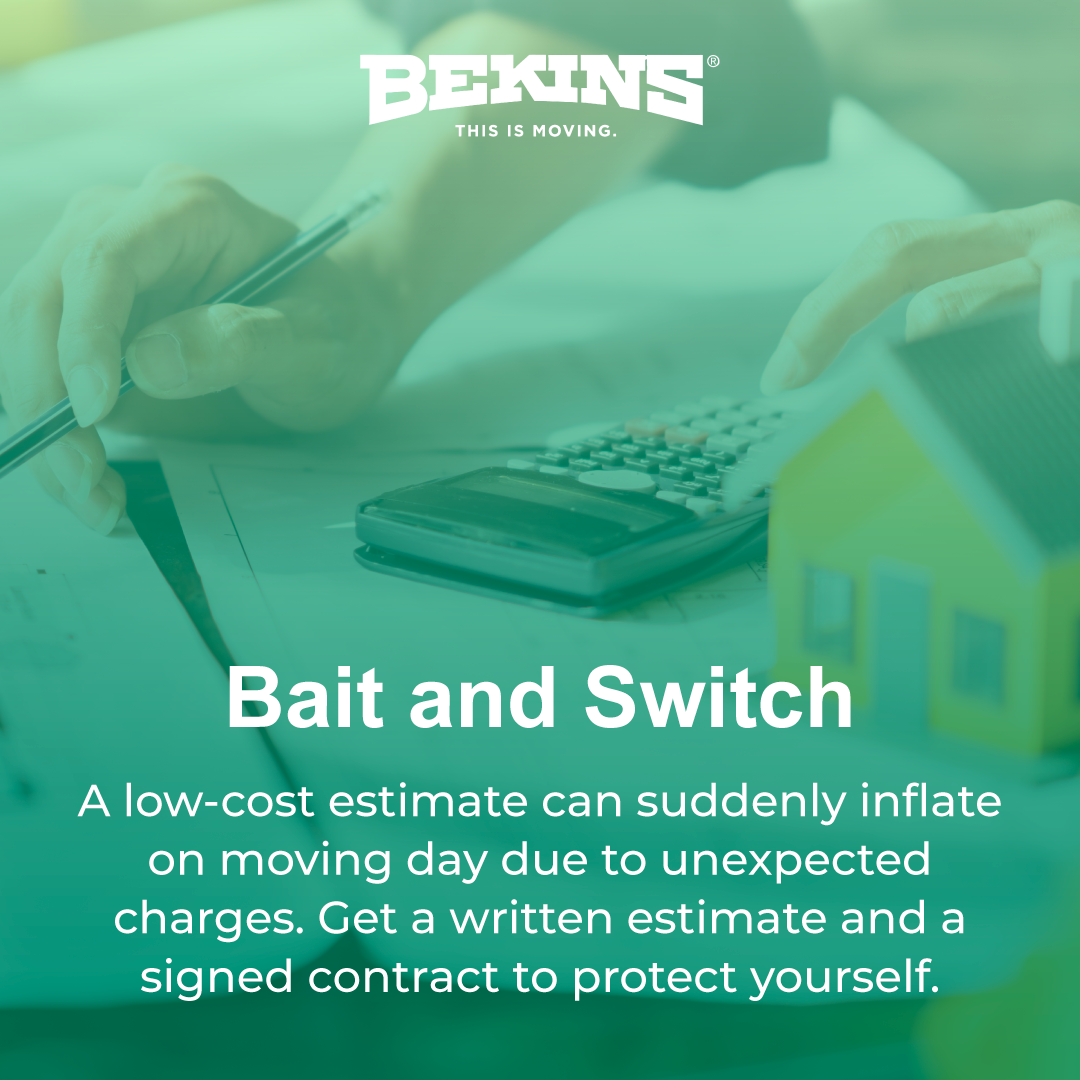
A mover gives you an artificially low quote to win the job. They’re not planning to honor it. The escalation happens through “extras,” such as charges for packing materials you didn’t request, fuel fees added after the fact, and hourly rates that somehow balloon past the quoted range. By the end, you’ve paid significantly more than you agreed to, but no single charge is dramatic enough to feel clearly fraudulent.
This is sometimes called “lowballing,” and it’s legal in the sense that each added charge is technically disclosed somewhere. The scam is in the structure: the initial number was never real, and the mover knew it.
The tell is the estimate process itself. A mover who quotes low without seeing your home isn’t making an educated calculation. They’re giving you the number most likely to win the business, with no commitment to it.
Moving Surveys and Estimate Protection
Bekins helps you avoid this before moving day arrives. Every move starts with a thorough in-home or video survey so your estimate reflects what’s actually being moved. From there, you choose the estimate type that fits your situation: a non-binding estimate, a binding estimate, or a not-to-exceed estimate that caps your cost while allowing the final price to come in lower if the job is simpler than expected.
Whichever you choose, the terms are clear and in writing before anything is loaded. There are no surprise line items on delivery day. If you want to understand exactly what your move covers before you commit to anything, our valuation protection page walks through how Bekins protects your belongings and your agreement from the start.
3. Damaged, Missing, and Stolen Belongings
Not every moving scam is about the bill. Some are about what arrives…or doesn’t. Rogue movers steal, mishandle, and in some cases intentionally damage belongings during a move. The opportunity is obvious: your possessions are packed, loaded, and in transit with people you’ve just met, with no visibility into what happens between your old front door and your new one.
A disreputable operation treats that window as an opportunity. Items go missing. Furniture arrives broken in ways that don’t happen by accident. Family heirlooms that are irreplaceable by definition are gone.
The damage isn’t always dramatic. Sometimes it’s a box of valuables that simply doesn’t make it off the truck. Sometimes it’s furniture that arrives with damage significant enough to be worthless but not obvious enough to prove it was intentional. By the time you know something is wrong, the mover is gone, and the leverage has shifted entirely to them. This is where who you hire matters as much as what you sign.

Valuation Protection
Bekins’ valuation protection gives your belongings a defined level of coverage before the move begins, so that if something is damaged or missing on the other end, you’re not left negotiating from nothing. You choose the coverage level that fits what you’re moving, including full valuation protection for moves involving items that can’t be replaced at any price.
4. Moving Broker Scams
With moving broker scams, the mechanism is fundamentally different; many people don’t realize they’ve hired a broker at all. You may have found a polished website, read reviews, gotten a low quote, and paid a deposit thinking you were hiring a moving company.
A moving broker is not a moving company. They don’t own trucks. They don’t employ movers. They are a middleman who takes your money and then finds a carrier to actually do the move. This happens sometimes at the last minute, and you don’t have a say in who moves you; you get whoever will take the job at the margin the broker has left them.
On moving day, unfamiliar movers show up…or no one shows up at all. If movers do arrive, the price often changes. If something is damaged, the broker says it’s the carrier’s problem. The carrier says talk to the broker. You’re caught between two entities, neither of whom feels responsible.

Verify Who You’re Hiring
The FMCSA requires brokers to disclose that they are brokers, not carriers. Many don’t. Some use names that sound like established moving companies. Some present themselves as local movers when they operate out of a call center in another state.
The FMCSA mover database shows whether a company is registered as a carrier or a broker, or not registered at all. If the company you’re speaking with is a broker, ask who the carrier will be and look them up separately before you pay anything.
Bekins operates through a network of independent agents. Agents are vetted, credentialed carriers who are accountable to Bekins standards. You’re not getting whoever accepts the load at the last minute.
5. No-Show Movers and Phantom Operations
Some moving companies’ scams involve no one showing up at all. In this scenario, you’ve booked a mover, confirmed the date, packed everything, and are ready to go. Moving day arrives, but the truck doesn’t, and your calls go unanswered. The number you have may still ring, or it may already be disconnected. Either way, you’re standing in an empty house with your life in boxes and no way to move it.
In some cases, the mover does show up, loads everything onto the truck, and then disappears. They never make a delivery, and your belongings are simply gone.
In both versions, the operation was never real, or was real enough only to collect a deposit and vanish. By the time you realize what’s happened, there’s no company to hold accountable; no physical address, no registered carrier, no paper trail that leads anywhere useful. These are often the same phantom operations built to look legitimate just long enough to close a booking.

Check Credentials First
The FMCSA mover database exists partly for this reason. A company with no USDOT registration, or one whose registration doesn’t match the name and address they’ve given you, is a significant warning sign before you’ve handed over anything. Verifying credentials takes minutes and closes the door on the most brazen version of this scam entirely.
Working with an established carrier with a verifiable history and a network of accountable agents is the more durable protection. Bekins’ independent agent network means the people handling your move are known entities with reputations tied to standards they’re held to.
7. Fake Companies and Identity Theft of Legitimate Movers
Some operations don’t build a brand; they steal one. This moving company scam involves creating a shell company that mimics a legitimate, well-reviewed moving company, with a similar name, copied website content, fabricated reviews, and sometimes even a spoofed phone number.
The person calling back sounds professional, the paperwork looks official, but the company doesn’t exist in any meaningful sense. Payment is collected, sometimes for a deposit, sometimes in full. On moving day, no one arrives. By then, the phone number is disconnected.
This scam also runs in reverse: a real company’s reputation gets used to launder bad reviews. Fake positive reviews inflate the profile of a scam operation. Fake negative reviews are sometimes posted against legitimate competitors to game search rankings.
Confirm With the Company You Think You’re Talking To
Bekins has operated under the same name and reputation since 1891, and that history can’t be cloned or spun up overnight. Our independent agent network consists of credentialed carriers whose identity and standing are verifiable, not self-reported. If someone is presenting themselves as a Bekins agent, you can confirm it. That traceability is precisely what a phantom operation can’t replicate.
AI Moving Scams: The 2026 Threat
This is the newest layer, and most moving guides haven’t addressed it yet. AI has given scammers tools that meaningfully change the threat level.
- Cloned company websites at scale. It now takes minutes to generate a professional-looking website for a moving company that doesn’t exist. These sites include stock photos, fake testimonials, plausible “About Us” copy, and contact forms that feed into a call center. The visual quality that once signaled legitimacy no longer does.
- AI-generated phone calls. Voice cloning and conversational AI mean that a “salesperson” booking your move may not be a person at all. AI voices can answer questions naturally, adjust to objections, quote prices, and confirm booking details, all without a human in the loop. You may believe you’ve spoken with someone and built some rapport when you’ve interacted with a system designed to extract a deposit.
- Fake reviews at volume. Generating hundreds of plausible, varied reviews across multiple platforms used to require a team. AI produces them instantly. This has degraded the reliability of online reviews as a signal for moving company legitimacy more broadly.
The signals that once indicated a trustworthy mover, like a good website, positive reviews, and an actual phone conversation, are now replicable by anyone. This doesn’t mean you can’t evaluate movers; it means you have to rely on verifiable credentials rather than surface presentation.
Check the FMCSA database for complaints. Confirm a physical address and visit it if possible. Ask for the USDOT number and verify it with the Department of Transportation. Ask who specifically will perform your move and whether they are employed by the company or a subcontracted carrier. These questions don’t have AI-generated answers because they require verifiable facts.

How to Avoid Every Scam on This Page
Every scam here has a structural weakness at the point before control transfers. Taking the following steps keeps you on the right side of that moment.
- Get a binding estimate in writing after an actual survey of your home.
- Verify the company’s USDOT number in the FMCSA database before signing anything.
- Confirm whether you’re hiring a carrier or a broker, and if a broker, who the carrier will be.
- Never pay in full before the move. A legitimate mover doesn’t require it.
- If a quote requires urgency or a deposit before you can ask questions, slow down.
For more on what these scams look like from the outside, see our guide to signs of a moving scam and learn more about how Bekins protects you from rogue movers.
You’ve Read the Playbook on Moving Scams. Now Choose a Mover Who Doesn’t Run It.
Moving should be one of the most straightforward transactions you make. With Bekins, it is. Get a quote from a mover with the credentials, history, and standards to back it up to make sure moving company scams aren’t part of your journey.